
Episode 3 | Capital to Progress: What We Did With the Money
The Throttle Up Podcast
Guest: Sascha Deri, Founder and CEO of bluShift Aerospace
Host: Justin Starbird
Introduction
What does it actually take to build a rocket propulsion company from the ground up? And how do you turn early investment capital into meaningful engineering progress?
In Episode 3 of the Throttle Up Podcast, host Justin Starbird sits down with Sascha Deri, Founder and CEO of bluShift Aerospace, to explore how the company has transformed early-stage funding, federal contracts, and investor support into real propulsion infrastructure, engine testing capabilities, and a pathway toward commercialization.
The conversation goes beyond fundraising numbers. It explores what those investments made possible, the challenges of developing aerospace technology, and the strategic decisions that have shaped bluShift’s journey.
From a small research prototype to full-duration engine testing, Sascha shares how the company has worked to turn ambitious engineering goals into measurable milestones.
From Early Funding to Real Progress
Every aerospace company starts with an idea. Turning that idea into a functioning propulsion system requires years of development, testing, infrastructure, and investment.
For bluShift Aerospace, an important early milestone came through a NASA Small Business Innovation Research (SBIR) contract that supported development of its initial engine prototype.
Following the company’s Stardust launch, growing interest from supporters and potential investors encouraged bluShift to pursue equity crowdfunding.
According to Sascha, the company raised more than $1.4 million through its early crowdfunding efforts. That capital helped bluShift move beyond small-scale research and begin developing the larger propulsion systems it had envisioned.
The investment supported several important capabilities:
Construction of an engine test stand designed to accommodate up to 50,000 pounds of thrust.
Development of vertical testing infrastructure.
Expansion of the engineering team.
Relocation from a small garage workspace to a hangar.
Engineering analysis and development needed to scale the propulsion system.
These investments created the foundation for larger-scale engine development and testing.
Rather than treating fundraising as the final achievement, bluShift focused on what each investment could enable the team to build, test, and demonstrate.
Why Rocket Propulsion Development Is So Expensive
Developing rocket engines is not simply a matter of designing components and assembling them.
It requires specialized infrastructure, engineering expertise, extensive testing, and safety considerations.
During the episode, Sascha explains how different propulsion technologies introduce different engineering and financial challenges.
Solid rocket motors require careful management of energetic materials and associated safety risks. Liquid rocket engines can involve highly complex systems requiring substantial engineering resources.
bluShift has pursued a hybrid propulsion approach that Sascha believes can reduce some of those complexities.
By simplifying aspects of the engine architecture and development process, the company aims to reduce the infrastructure and personnel requirements associated with propulsion development.
Sascha emphasizes the importance of the KISS principle: keeping engineering systems as simple as practical.
For bluShift, simplicity is not about compromising capability. It is about reducing unnecessary complexity so that a smaller team can develop, understand, test, and improve the complete propulsion system.
Combining Private Investment With Government Funding
One of the central themes of Episode 3 is how bluShift has combined different sources of capital to advance its technology.
Early private investment helped the company develop its infrastructure and expand its engineering capabilities.
That investment was complemented by non-dilutive government funding, including contracts associated with the U.S. Space Force and U.S. Air Force.
Sascha explains that this funding supported development of the full-scale engine and additional work to improve its suitability for booster applications.
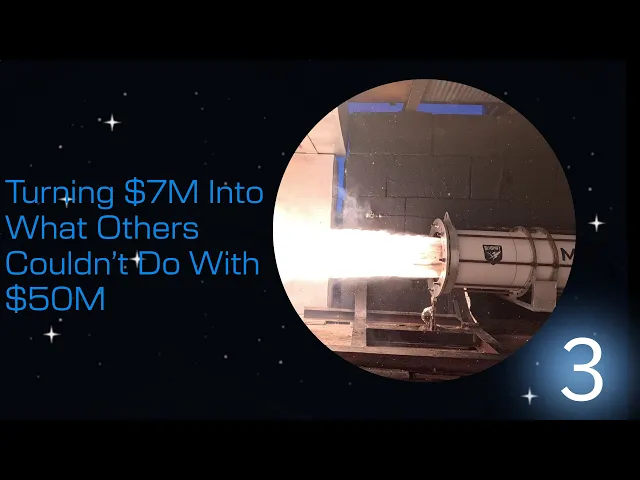
At the time of the conversation, he estimated that bluShift had raised approximately $7 million in combined private investment and non-dilutive funding, with a roughly equal contribution from each category.
He contrasts this with his estimates of the significantly larger capital requirements faced by companies developing comparable propulsion capabilities using other technologies.
The broader lesson is that the value of capital is measured not only by the amount raised, but also by the capabilities and milestones it helps deliver.
From Prototype Engines to Full-Duration Testing
One of bluShift’s most important achievements discussed in the episode is its progression from small research engines to much larger propulsion systems.
Sascha describes the difference between an early engine small enough to transport by hand and a full-scale system requiring forklifts, cranes, and substantial supporting infrastructure.
Scaling an engine introduces challenges beyond propulsion engineering. Larger systems require additional structural, mechanical, and civil engineering considerations.
According to Sascha, bluShift has demonstrated engine operation at up to 20,000 pounds of thrust for approximately 60 seconds.
This represents an important distinction between short-duration testing and demonstrating that an engine can operate through its intended full-duration burn.
For the team, these tests provide engineering data and evidence of progress toward future flight applications.
Sascha also recalls a particularly meaningful test in which the engine’s performance suggested that a suitably configured flight vehicle could reach suborbital space.
That result represented years of development and helped demonstrate what earlier investment had made possible.
Building Infrastructure That Supports Future Development
Beyond the engines themselves, bluShift has invested in facilities and equipment that support continued propulsion development.
The company’s test infrastructure allows engineers to conduct engine tests, gather performance data, evaluate design changes, and prepare for future development milestones.
These facilities are also valuable when demonstrating the company’s progress to investors and partners.
Sascha describes how visitors respond when they see the infrastructure and engineering capabilities bluShift has built.
He also explains that the company has made its testing facilities available to regional universities working on smaller rocket engine projects.
This creates opportunities to support engineering education, build relationships with future aerospace professionals, and contribute to the broader regional aerospace community.
The infrastructure represents more than a collection of equipment. It is a long-term capability that supports continued testing, development, and potential commercialization.
Why bluShift Shifted Its Market Strategy
An important part of the discussion focuses on how bluShift’s commercial strategy has evolved.
The company’s earlier ambitions centered heavily on launching small satellites into orbit.
However, the orbital launch market presented significant challenges, including competition, capital requirements, and the time needed to reach commercialization.
As bluShift evaluated its technology and the market, the team identified additional opportunities for its propulsion systems.
Sascha explains that demand for alternatives to conventional solid rocket motors helped influence the company’s growing focus on booster and hypersonic applications.
The company’s hybrid propulsion technology offers characteristics that could be valuable in these markets, including controllability and the potential for a different cost structure.
This shift did not mean abandoning the company’s underlying propulsion technology.
Instead, bluShift began focusing on applications where its existing engineering capabilities could address nearer-term commercial needs.
For Sascha, the challenge is balancing long-term aerospace ambitions with the practical realities of available capital, market demand, and the path to revenue.
The Importance of Community Investment
Financial support is only one part of bluShift’s relationship with its investors.
Throughout the episode, Sascha emphasizes the importance of the community that has developed around the company.
Following the Stardust launch, bluShift attracted supporters interested in aerospace innovation, alternative propulsion technologies, and the company’s approach to development.
Some became investors. Others contributed encouragement, industry knowledge, professional connections, and technical perspectives.
Sascha describes how conversations with investors can provide useful insights and introduce the team to resources they might not otherwise discover.
He also values the opportunity to share both successes and challenges openly.
Aerospace development involves setbacks, unexpected engineering problems, and changing priorities. Sascha believes transparent communication helps investors understand the realities of building a hard-tech company.
The community’s support extends beyond financial participation, creating relationships that help sustain the team through the challenges of development.
What Previous Investment Has Made Possible
Looking back at the company’s progress, Sascha identifies several milestones that reflect the impact of previously deployed capital.
These include:
Development of larger hybrid rocket engines.
Demonstration of full-duration engine burns.
Construction of large-scale propulsion testing infrastructure.
Expansion of engineering and technical capabilities.
Securing government development contracts.
Progress toward booster and hypersonic propulsion applications.
Establishment of relationships with investors, research organizations, and commercial partners.
Together, these achievements illustrate the company’s progression from early research toward a more mature propulsion development platform.
For Sascha, the most compelling evidence is physical: the engines, the test facilities, and the results of completed tests.
They provide tangible examples of how funding has been converted into engineering capabilities.
What Comes Next: From Testing to Commercialization
The final part of the conversation looks toward bluShift’s next stage of development.
Sascha explains that the company’s focus is on advancing from its current engine testing platform toward flight-ready propulsion systems and commercial applications.
That process includes further engine development, performance improvements, testing, and eventual flight validation.
He also discusses the potential role of additional private capital, government support, and commercial partnerships in financing the next phase.
At the time of the recording, bluShift was planning additional engine tests, including technical improvements intended to support future work with hypersonics partner Spector Aerospace.
Sascha also discusses potential matching capital of up to $2 million from the Maine Technology Institute to support capital expenditures.
These plans represent future development objectives rather than completed milestones.
The goal is to build on the infrastructure and technical progress already achieved and move toward commercial deployment of bluShift’s propulsion technology.
Turning Capital Into Capability
Episode 3 of the Throttle Up Podcast offers a closer look at what it takes to build a propulsion company in an industry where progress is measured in years, engineering milestones, and repeated testing.
The story of bluShift’s development is not simply about how much money the company has raised.
It is about what that funding has enabled: infrastructure, engineering talent, larger propulsion systems, testing capabilities, and new commercial opportunities.
From its early NASA-supported prototype to full-duration engine testing and an evolving focus on booster applications, bluShift has continued to adapt its strategy while developing its core technology.
As the company works toward future flight milestones and commercialization, the lessons from its earlier funding rounds remain central to its approach.
The message of this episode is clear: raising capital creates opportunity, but turning that capital into measurable progress is what moves an aerospace company forward.
