
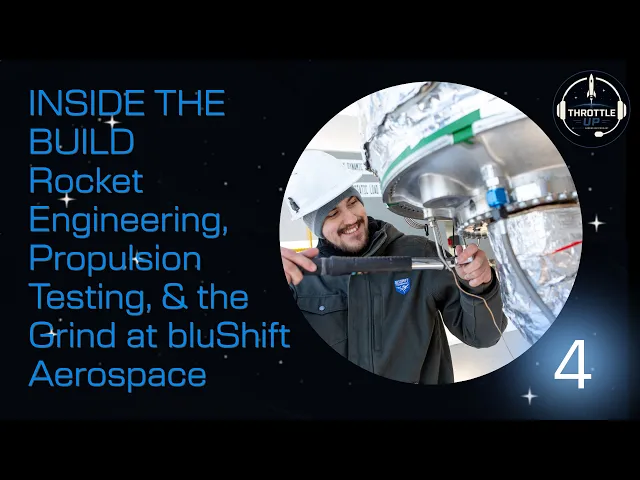
EP 4 | INSIDE THE BUILD
The Throttle Up Podcast
When you think of rocket development, you probably picture a massive launch, but the real work, the years of disciplined, methodical engineering, happens behind closed doors. In this episode of The Throttle Up Podcast, host Justin Starbird invites two central figures at bluShift Aerospace, Lead Mechanical Engineer Luke Saindon and Lead Propulsion Test Engineer Gerard Desjardins, to peel back the fuselage and show what it takes to build a next-generation rocket motor.
Modeling Meets the Motor: Balancing Theory and Reality
For Luke, the process is an iterative dance between theoretical optimization and real-world compromise. Luke is the "big brain" of the operation, using high-level language like MATLAB to model the propulsion system’s performance, predicting everything from propellant relations and nozzle geometry to the vehicle’s overall flight path. This modeling is crucial for finding the optimal balance between a high-performing motor and a low-weight vehicle, a critical trade-off in aerospace.
Gerard then takes these complex models and moves them into the physical domain. He describes test day as a high-stakes performance where weeks and months of planning culminate in a single critical moment. The team operates in cycles of peaks and valleys; achieving a goal is a peak, but then, as Luke notes, "we still have 99 others" to figure out.
Honing in on Performance and Stability
The bluShift team is currently laser-focused on hitting specific performance markers for their upcoming suborbital goal, Starless Rogue. For the next engine test, they are specifically targeting improved combustion efficiency and better burn stability (the smoothness of the engine run over time).
The philosophy guiding these decisions is one of disciplined pragmatism. Luke explains that while they have aspirations of using cutting-edge materials like carbon-carbon composites, they prioritize using simple, well-understood, and available materials, such as stainless steel for the oxidizer tank and combustion chamber, to keep costs low and maintain momentum.
This methodical approach ensures that even when they eventually transition to lighter materials for even higher performance, the foundational problems solved today will carry over. Ultimately, as Gerard notes, the biggest success isn't just hitting a number, but running a "successful safe test" that collects the necessary data for the next phase of learning.
If you’re fascinated by the methodical process of engineering, the high-stakes world of propulsion testing, or just want to hear the honest truth about building a rocket company from the ground up, this episode is essential listening! Tune in to hear Luke and Gerard discuss the compromises, the constant focus, and the satisfaction of building something that will truly reach the stars.
